Soda Springs winters keep ice on the ground for months, and your senior pet can get around fine indoors yet still lose their footing the first time out on a frozen walkway. The aids that help range from toe grips and rugs at home to a support harness or a cart, and the one your pet needs is decided by what is causing the trouble, not by their age. Most of the time that cause is osteoarthritis, which is treatable rather than inevitable. Starting while your pet still has muscle and confidence prevents the falls and guarding patterns that speed decline, and waiting until the struggle is obvious means rebuilding from a weaker place.
Watching your older pet lose confidence on their feet is hard, and it is easy to assume nothing can be done about it. At Soda Springs Animal Clinic we start with the cause rather than the product, using a hands-on senior wellness exam and X-rays to tell arthritis from a disc or nerve problem before you buy a single piece of gear. For chronic arthritis and long-standing soft tissue injuries, we prepare and administer PRP therapy right here, one more way to keep an aging dog or cat comfortable enough to stay on their feet. If your pet is scrabbling on the ice or hesitating at the bottom of the stairs, give us a call and we will find out what is actually slowing them down.
The Short Version Before You Shop for Gear
- Slowing down is a symptom, not a diagnosis. In most seniors it traces back to arthritis, and arthritis can be treated.
- Think in stages. Grip aids come first, a lift harness carries the middle stretch, and a cart takes over once the hind legs quit.
- Arthritis, a slipped disc, and a nerve disease each follow a different path, and the diagnosis tells you how fast the gear will need to change.
- No strap or wheel treats what's underneath. Pain relief, a leaner body, and muscle work do as much for your pet as anything you can buy.
Is This Just Old Age, or Is Something Treatable Going On?
Age by itself doesn't stiffen a joint. What most families write off as getting old is usually osteoarthritis, a disease we can treat rather than a fixed feature of the senior years, and putting a name on it early is what keeps a dog or cat on their feet longer.
The first step, then, is never a purchase. A hands-on exam shows us where the weakness lives, and in-house x-rays and bloodwork sort a joint problem from a disc or nerve problem before anyone spends money on gear.
Which Stage Is My Pet In Right Now?
Mobility loss tends to move through three rough stages, and the stage picks the gear. Early on, the problem is grip. In the middle, the hind end needs a steadying hand at the hard moments. Late, the back legs can't carry weight at all. Here they are hardest first, since "is my dog there yet?" is the question that brings most families through our door, and most pets are further from that row than they fear.
| Stage | Signs you'd notice | The tools that fit |
| Advanced | The hind legs won't hold, standing takes a lift, and once down your pet tends to stay down | A wheeled cart, a harness that lifts front and back, and someone home to keep an eye on them |
| Moderate | Rising takes help, a short walk wears them out, the hindquarters sway or wobble | A lift harness, medication for pain, and exercises that rebuild strength |
| Early | Stiff first thing after a nap, paws sliding on hard floors, slower stairs, no more leaps onto the couch | Nail grips, rugs and runners, a ramp, and joint support |
Pets don't move through these rows in order. A ruptured disc can drop a dog from the “Early” row to the “Advanced” row overnight, and a cat can sit comfortably in the “Early” row for two years. That is the reason we like to put our hands on a senior for a nose-to-tail physical twice a year: the slide from one row to the next is easiest to catch while there's still muscle worth protecting.
What's Driving the Change in How My Pet Moves?
Three conditions account for most senior mobility loss, and arthritis leads by a wide margin. Here is how each one behaves, because the diagnosis decides the plan:
- Arthritis in the joints: The everyday version. A harness eases the hard moments while pain control and weight loss work on the joint itself. Gear on its own never gets a stiff dog all the way back.
- A disc pressing on the spinal cord: Intervertebral disc disease can turn an ordinary morning into sudden hind-end weakness or paralysis. Recovery usually runs through a rear harness, and some dogs stay in a cart for good. Dachshunds, Corgis, and Beagles carry more of that risk than most breeds. When a case needs advanced imaging, we arrange the referral to a specialty hospital ourselves.
- A slow nerve disease of the back end: Degenerative myelopathy only travels one direction. Support climbs over months from traction aids to a harness and finally to wheels. It doesn't hurt, and that painlessness is exactly what gets it mistaken for sore hips at the start. German Shepherds and Boxers are overrepresented.
Less often, the trouble is a dysplastic hip, a torn cruciate, a tick-borne infection, or a bone tumor, and each of those calls for a different treatment plan than any of the three above.
| Condition | The first thing you'd notice | How fast it moves | Does it hurt? |
| Disc disease | A sudden wobble, a yelp, one or both hind feet dragging | Fast, sometimes within hours | Often badly at the start |
| Osteoarthritis | Slow to get up after a nap, a slower climb on the stairs | Gradual, over months to years | Yes, and treating the pain changes a lot |
| Degenerative myelopathy | Rear paws scuffing and crossing, nails worn down on top | Steady decline over many months | No, and that's the reason it's missed early |
What Helps When My Dog Is Just Slipping on the Floor?
At this stage the legs still work. Grip and comfort are the whole problem. Paws that scrabble and splay on tile need something to catch, and rubber toe grips slip over the nails to give each foot exactly that.
Outside is its own challenge from November on. Gravel, ice, and the slick stretch from the door to the truck call for traction booties, which add grip outdoors and shield toes that have started to drag.
Indoors, the house does more work than any single product. A ramp over the two porch steps, runners across hard floors, and raised food and water bowls are the arthritis-friendly home changes that take load off sore joints before any device is needed.
Go slowly with all of it. An older pet who wakes up to a rearranged house tends to dig in. Put down one runner, let it become ordinary, then add the next. Anything that slides underfoot teaches a wary dog that the new thing can't be trusted.
How Do Senior Cats Show Mobility Trouble Differently?
Cats hide pain far better than dogs. Trouble in an older cat almost never looks like a limp. It looks like a change in habit, and that reads easily as a cat simply getting quieter with age. Those small shifts deserve the same workup a limping dog would get.
Worth watching for:
- The jump to a favorite perch stops, or becomes a two-step climb by way of a chair.
- Stairs get taken one at a time, or get avoided altogether.
- A hesitation at the edge of the litter box, or accidents just outside it.
- New napping spots at floor level instead of the old high ones.
- A coat that's gone dull or clumpy along the spine and hindquarters, because twisting to groom there hurts.
- Less interest in play that used to be automatic.
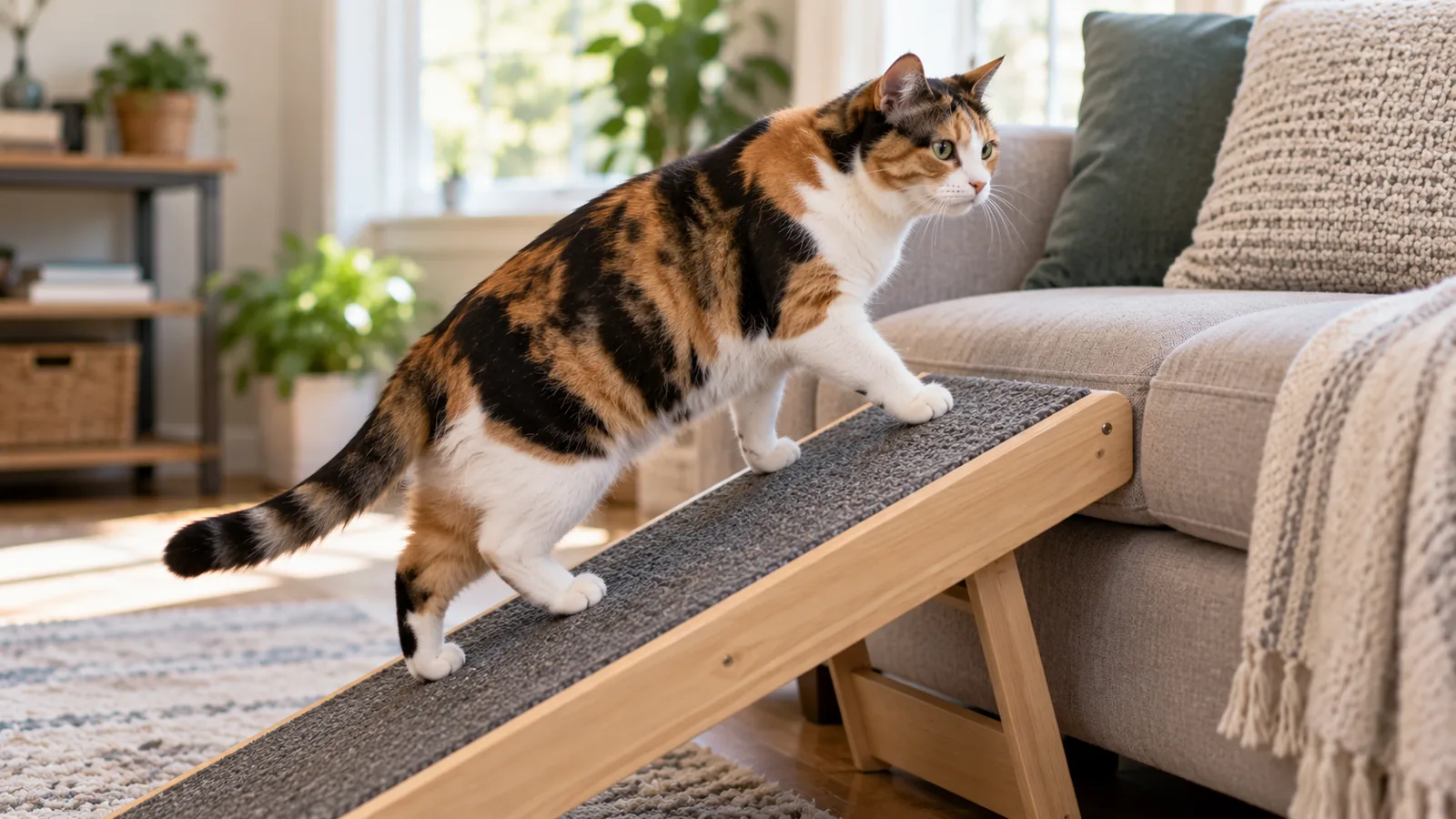
Low-entry litter boxes, a step up to a favorite windowsill, and soft resting spots at floor level are the home modifications for cats that often buy months of comfort before any device comes up.
Our wellness plans make it easy to have an aging cat looked at the week you notice one of these changes, rather than filing it away until the next annual visit.
Does My Pet Need a Harness, or Are They Ready for Wheels?
A harness is for the pet who can still carry weight but needs a hand at the hard moments: getting up off the floor, stairs, the walk back up an icy driveway. Wheels come in once the hind legs can't hold weight or take a step. Most dogs spend a long stretch in harness territory first.
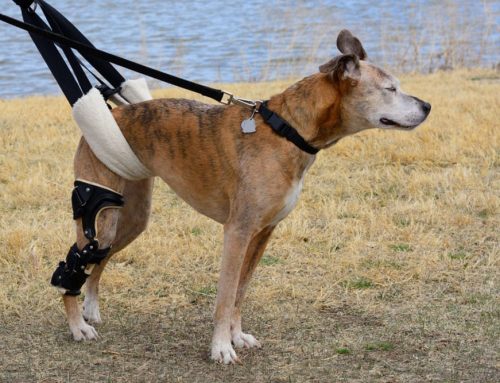
- Weakness behind: When the trouble sits in the hips, a rear-support harness cradles the hindquarters and puts a lift handle right where you need it for stairs, curbs, and the step up into the truck.
- Weakness in front: Front-support styles do the same job for a dog who's down a front leg or losing strength through the shoulders, where a rear-end design would only tip them forward.
- Weakness at both ends: A senior who wobbles front and back needs lifting at both ends, and that's the job of a full-body support harness with handles over the shoulders and the hips.
- Knuckling and scuffing: Hind paws that fold under or scrape the pavement often land better with resistance bands that guide the leg through each step and keep the muscles working. Knuckling socks are the simpler option, protecting the tops of the toes and nudging the foot into a better landing.
The name on the label matters far less than how the harness sits on your dog. One that rubs an armpit or rides too far back trades one problem for another. We'd rather have our team size and adjust it in person than guess from a chart.
Once the hind legs are past holding a dog up, mobility carts hand back the freedom to move, sniff, and stay part of the family's day. Wheels aren't where a dog lands after everything else has failed, and they aren't an all-day chair either. A cart is for outings: the yard, the loop around the block, the sniff along the fence line. Sizing has to be exact, since a frame that rubs raises a pressure sore faster than you'd expect. Give your dog a week or two of short, cheerful sessions before expecting much. Plenty of senior dogs go on living busy lives on wheels.
What Else Belongs in a Senior Mobility Plan?
A device holds a pet up. It doesn't treat what's underneath. Pain control, weight management, and strength work do that, and they decide how much good any harness or cart can do. Most plans stack three or four pieces together, and the mix changes as your pet does.
- Weight: Every extra pound lands on joints that already hurt. Trimming body condition often does more for a stiff dog than anything you can order online.
- Pain control: Anti-inflammatories are the backbone for arthritis. For dogs and cats who can't take them or need more, a monthly monoclonal antibody injection is an option, and gabapentin and similar add-ons cover the discomfort that inflammation drugs leave behind.
- Rehabilitation: Veterinary physical rehabilitation builds the targeted strength and balance that make any device usable.
- Joint supplements and omega fatty acids: In the right patient, these take a little of the edge off inflammation and help protect cartilage over the long haul.
- Rechecks: A senior's needs shift over months rather than years. A scheduled look every few months keeps you ahead of the next stage instead of reacting to it.
For arthritis that has been building for years, platelet-rich plasma therapy concentrates healing factors from your pet's own blood into a sore joint, and it sits alongside pain control medication rather than replacing it.
Questions We Hear From Senior Pet Families in Soda Springs
Does leaning on a harness make a dog weaker?
Not when it's used for the hard moments and left off the rest of the time. Picture the frozen walk from the porch to the truck: your dog wears the harness for that stretch, then spends the rest of the day on their own legs. Paired with strength work, most dogs hold muscle better with a harness than without one, because they stop guarding a sore limb.
How long before a dog gets used to a cart?
Most dogs settle in within a week or two. Start with short sessions somewhere familiar, keep the mood light, and quit before your dog gets tired or frustrated. Treats work better than coaxing. Check the skin under every strap daily at first, because rubbing sours a good cart faster than anything else. A dog still fighting the cart after two weeks usually has a fit problem rather than a stubbornness problem, and an adjustment often solves it in one visit.
My cat won't put up with anything strapped on. What works instead?
Most cats refuse gear, and most cats don't need it. Changing the house does more for them anyway: a litter box with a low entry, a step or two up to the sill they've always used, food and water on the level where they sleep, and rugs across the slick stretches. Add pain control suited to cats and a surprising number go back to perches they'd abandoned months earlier.
Keeping Your Senior Moving Through Another Soda Springs Winter
Slowing down is not the same as being done. Match the aid to the stage, pair it with pain control and strength work, and most dogs and cats stay part of the household routine well past the point their families feared, and all of it begins with putting a name on what changed. If your dog hesitates at the bottom of the stairs, or your cat has quietly given up the windowsill, book a senior mobility check at Soda Springs Animal Clinic and we'll find out what's behind it. We've walked a lot of seniors through a lot of hard winters, and we'd much rather look now than after the first bad fall.